Rob Cheng's Blog

The Fruits of Brazil

I really love living in Brazil. One of the major reasons are the many fruits that can only be found in Brazil. Here is my list of favorites:

1. Agua de Coco. This is the water inside of the coconut. After I run in the morning, I drink about 1.5 liters of agua de coco during the cool down period. It tastes so good. Plus it is very good for you. Agua de coco is high in sodium and pottasium, and very low in calories and fat. When in the United States, I could not find agua de coco anywhere, so I usually drink GatorAde or PowerAde. I actually think that agua de coco is a superior and natural energy drink. It sounds corny but agua de coco truly quenches my thirst, where as GatorAde just satisfied the thirst. Here’s my tip for agua de coco. Never drink at room temperature. It must be cold and the colder the better.

You also can get it on the beach. There they take a large knife to the top of the coconut, and then you drink it through a straw. Note: if the beach is crowded, quite often the coconuts will not be very cold and it is a little less than satisfying.

2. Açaí. This is a fruit about the size of a grape, and the pulp is mashed and frozen and shipped throughout the country. You can buy it in any super market. It is also a favorite at the many juice stands throughout the city. There is only one word for this drink/slurpee, delicious. Lately, I have been making it at home. Here’s my recipe. Take two packages of frozen açaí, and smash them gently with a small hammer. I use the side of a meat tenderizer. Be gentle because you don’t want to break the package just smash up the frozen stuff. Then put it in the blender until the açaí is small and a little dusty. Then throw in a banana, and mix it with the açaí. Take it out of the blender and place it in a bowl and mix in two tablespoons of guaraná syrup and granola to taste. Then start eating! Just thinking about it now, makes me want to go to the kitchen and make another one.

3. Maracujá. This is a bitter fruit about the size of a wrinkled pear. For lunch, we make it into a juice mixed with water and lots of sugar to remove the bitterness. Nice and refreshing.

4. Pineapple. This is of course not unique to Brazil, but in my experience some of the finest pineapple in the world is from Brazil. The question at hand is whether the pineapple is sweet and juicy. From my experience in both the United States and Brazil, Brazil wins hands down. Not all pineapples are good, but the probability is very high in Brazil (~80%) that you get a sweet and juicy pineapple, where as in the US I would guess the number is a lot less than 50%.

5. Caipivodka de Morango. This is one of my favorite alcoholic drinks in Brazil. It is easy to make but not available in the US. First you mash up some strawberries very fine, and then put them in the blender. Liberally throw in vodka, and serve over ice. Note: it normally comes with sugar in it, but I request it without sugar and put in sweet-and-low at the table.

I also have a list of fruits that are better in the United States. Oranges and sweet corn (in season) are a lot better in the US.

One thought on “The Fruits of Brazil

  1. -Agua de Coco is really nice. Funny you cant get it in US. After all, all coconuts are “water” inside it, before they get old, lose the external green cover and only the brown, hairy shell remains (by then, most water inside will have dried, but the layer of white cream inside will have got thicker)

    -maracuja is called “passion fruit” in english right? Is it hard to find in US?

    -pineapple: according to Wikipedia, pineapple is a fruit natural to southern Brazil, and it was spread out to the rest of the world by the europeans. I did not know that.

Leave a Reply

Your email address will not be published. Required fields are marked *


Portuguese Vowel Sounds

Here’s a trick that I figured out to speak Portuguese with less of a foreign accent. It goes back all the way back to elementary school. Do you remember when you were learning your vowels, and we learned that there are 5 vowels and each vowel has two sounds, long and short?
Well in Portuguese (and also in Spanish), each vowel only has one sound. So therefore, rather than 10 vowel sounds in English, Portuguese and Spanish only have 5. The trick if you are an English speaker is to throw out the other vowel sounds because they do not exist in Portuguese. See the table below.

Vowel English
Pronunciation
Portuguese
Pronunciation
a ă, ā ŏ
e ĕ, ē ā
i ĭ, ī ē
o ŏ, ō ō
u ŭ, ū ū

Here’s a little example that me and some friends were discussing over dinner one night. The word entendo (I understand). My friends were pronouncing the word:

ĕntĕndō


And the more correct pronunciation would be:

āntāndō

One last point because the phonics are confusing because of where you want to accent the syllable. In general, when a word has no accent marks, then the accent should be placed on the second to last syllable. This is also key for proper pronunciation, and makes the first long a sound a little lighter than the second one in the example above.

Note: I am no expert on Portuguese, but hopefully someone will find this helpful.

One thought on “Portuguese Vowel Sounds

  1. I watched the video and I think it is two views of the same thing. Here are two reasons why:

    1. I tried to make the point about accents at the end of the post (probably not very well). The accented vowels (as in Spanish) indicate that that syllable should be accented. If there are no accents, then the accent by and large should be on the second to last syllable. When you accent the syllable, then at times there might be subtle changes in the pronunciation of the vowel, but a short-o is still a short-o. Either way, it is far more important to hit the accent on the right syllable than to modify the sound of the vowel.

    2. I view dipthongs as being an extension of the above rule. In English, you are never sure which vowel sounds you are blending, and it is much more straight forward in Portuguese. Using the examples above, pão, would be short-o + long-o. mãe is short o + long a. And so on.

    Anyways, my point was actually entirely different. One of the key things for English speakers is to remove certain vowel sounds such as short-e and short-i from their pronunciation.

  2. Robert, I posted on Mike´s blog calling the attention to the fact that there are only 5 vowel sounds in spanish, but in portuguese, there are many more. First, you have open and closed vowels. Than you also have nasalised dithong vowels (like in pão, mãe, põe).

    Check out the post and also this video from an english teacher, teaching about vowel sounds in portuguese.
    http://www.youtube.com/watch?v=uGjLYgA2gtA

Leave a Reply

Your email address will not be published. Required fields are marked *


The Bubble Recovery

One of the greatest travesties to this bubble is the incredible American deficit under the Bush administration. The deficit has ballooned by over $5T in a scant 8 years. We can all agree that this is highly fiscally irresponsible, but the question remains, “Where did all this money go?”
After all, Bush is a Republican, and the funds certainly were not spent on liberal causes such as welfare and education. Given the record price at the gas pump, the funds were not spent on alternative energies, or more energy efficient cars. In fact, I think that we can look back at the success of the Humvee as a unique product of the Bush administration.

So show me the MONEY. By all estimates, the war in Iraq has cost $500B, but let’s be generous and assume that all the money has been squandered and there is no economic return on the American economy. Furthermore, let’s round it up to $1T. So there is still $4T unaccounted.

The chart above explains a large portion of the Bush’s incredible $5T deficit. One of the first things Bush did as president was honoring his campaign promise to give huge tax cuts to the wealthy. This was signed into law in June 2001.

The impact was swift. Government tax revenues essentially fell off a cliff during Bush’s first term. Bush’s rationale was that the tax cuts would trickle down to the rest of the economy and create jobs. This chart suggests the opposite. If jobs had been created, then revenues would not have fallen. In fact, they should have gone up. Bush’s tax cuts to the wealthy did not create jobs. In fact, these tax cuts have substantially increased the deficit and perhaps was one of the underlying contributors to the bubble.

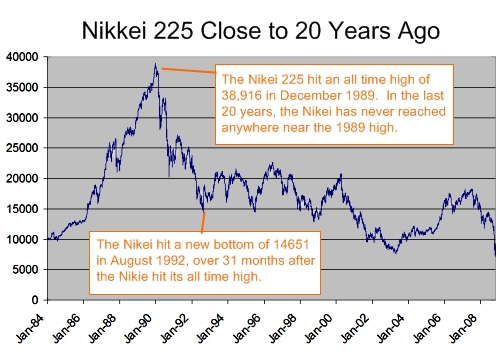
The Nikkei 225 is the Japanese version of the Dow Jones 500. This chart chronicles what is commonly referred to as the Japanese Asset Price Bubble. In addition to the run up in stocks, it was accompanied by a tremendous run up in real estate prices. Some places in Tokyo were being sold at over $100,000 a square foot. A square foot is the size of one floor tile, and it was selling for the price of an entire house. Sound familiar?

Once the bubble popped in 1989, the Japanese Federal Reserve continued to spur the economy by lowering interest rates and printing more money. These actions were ineffectual, and interest rates hit zero. Can you believe it? They were essentially giving away money and there were no takers. The credit crisis would not abate.

The last straw was when the government began to buy out failing banks and businesses creating what became known as zombie businesses. This era in Japanese history is known as the lost decade. Historians blame primarily the Japanese Feds insistence in lowering interest rates and bailing out failed institutions.

If you have not already figured out where this is going. We are repeating each and every mistake that happened in Japan beginning in the mid 80’s. We made the exact same mistakes as the Japanese that caused a stock and housing bubble. And now we are replicating their errors in resolving the problems. The end result for Japan was the lost decade, and perhaps the US is in store for a similar fate.

Leave a Reply

Your email address will not be published. Required fields are marked *


Measuring the Bubble (Depression Deja Vu)

The media is calling this bubble the worst since the Great Depression. That sure sounds scary, but where are the facts? What makes them believe this bubble is so severe relative to other bubbles? Are there any facts to feed the panic or just pure fear?

I decided to take a look at some of the facts to measure the bubble and finally set some expectations about the size of the bubble. First I looked at the average housing pricing for the last 45 years. I pulled all of the information from www.census.gov which is a terrific place to gather macro economic information.

Just quick look at the chart, and it is easy to see where the bubbles have occurred. There were indeed housing bubbles in 1969, 1980, and a slightly larger bubble in 1989. Once each bubble hit, the decline in housing prices never lasted more than one year. Until now.

It is clear from the data, that there was a tremendous spike in housing prices in 2005. Unbelievable as it might sound, housing prices jumped over 13% in one year! This was followed by a 9% jump in prices in 2006. Somebody was asleep at the wheel in the Federal Reserve. Warning bells were going off all around them, and they did nothing.

Perhaps the scariest part of the bubble is its sheer size. Not only are the spikes larger than any other historical precedent, the bubble has persisted longer than anything in the last 45 years.

The only good news on this chart is that median home prices appear to have peaked in 2007, and although the data is not yet in, it is a good bet that 2008 will be less than 2007. So it is clear that we are beginning the downswing, the only question is how long will it last. And how severe will it be?

Next let’s take a look at the same chart but including the average house price along side the median. There is some speculation that the root of the housing bubble is related to laws encouraging mortgages to minorities. This chart rebukes that theory.

There can only be one reason why the average is growing faster than the median. HIGH END HOUSING. Eyeballing the numbers, I would bet heavily that million dollar homes are driving the bubble, not $100K homes to minorities.

But wait, there is one more piece of bad news. The average house price was still growing rapidly in 2007. Note: that the median had hit a plateau. In fact, looking at previous bubbles, this is the first time that the average behaved differently than the median.

I worry about the underlying dynamics of our economy if the average is so much larger than the median. It suggest that the gap between rich and poor is growing. Living down here in Brazil, I believe that one of America’s strengths in the 60’s and 70’s was an extremely strong middle class.

But I don’t want to get off track. So the housing data looks bad. Of course, this was entirely preventable, but there is indeed some empirical evidence that this bubble could be equal to that of the Great Depresssion.

Lastly, let’s take a look at the Great Depression courtesy of Yahoo Finance. The Great Depression began in September 1929, when the Dow hit a peak of 380. The Dow did not hit bottom until close to three years later. Worse yet, it took over 25 years or a quarter of a century for the Dow to reach its pre-depression levels. Ouch! 25 years is a long time just to get back to break even on your stock portfolio.

Although there are some indications that this financial crisis could equal the Great Depression. I personally believe that we can do much better. But for the pessimists in the group (and the media as well), here is a simple forecast using the Great Depression as a guide line. Once we see these numbers, it is easy to see why some people decided to keep their money in a mattress. Much safer.

One thought on “Measuring the Bubble (Depression Deja Vu)

Leave a Reply

Your email address will not be published. Required fields are marked *


Why the Bailout Will Fail

Yesterday, the House of Representatives approved the $700B bailout plan, and President Bush quickly signed it into law. Sigh! What I dislike most about this bill was that everyone including the President was acting in a panic. No one was calmly analyzing the underlying magnitude of the credit crisis, and the fundamentals that would drive our great country so close to the edge of a cliff. I’ll try to do that here.

The first chart is a simple graph of the trend of our national debt. Bush inherited a $5.7T debt, and by the end of his presidency, it will most likely exceed $11T. In a short eight years, Bush and the Republicans have doubled the size of the deficit. Let’s put this another way. Bush created a deficit in eiqht years equal to all 42 presidents before him COMBINED. There are only two ways to create a disaster of this magnitude.

Create massive tax breaks. Not only must the tax breaks be massive, but they must provide little or no economic impact to the economy. This is no easy task, since normally tax breaks inherently give the economy a bump. Bush has proven with surgical accuracy that if you target the nation’s wealthiest citizens, as well as the wealthiest corporations such as Wall Street, oil companies, and pharmaceutical, it can be achieved. The key to Bush’s tax plans is to place as much money in as few hands as possible. Frankly, I would not have predicted it, but it appears to have worked like a charm.

Spend like there is no tomorrow. Once the Republicans took hold of both houses and the executive branch, it must have been like Dad giving the kids the keys to the summer home. LET’S PARTY! And party they did. There was no bill too expensive, and no earmark too small. Basically, there was no budget whatsoever. Of course, this bottomless-money-pit mentality also explains our stubbornness in exiting Iraq. In retrospect, it is amazing that the original budget for the war was $50B.

Look at the slope of the line during the last 7 years. We are in debt like we have never been in debt. America needs money and FAST!

Which brings me to the next graph. If we are plowing through money, and we have made a conscious effort to reduce revenue (through tax decreases), one would think that America would have high interest rates in an effort to attract capital. This is where things start falling apart. The exact opposite is true. While our need for other people’s money was reaching addictive levels, our price for that money (interest rates), was abnormally low.

It makes no sense. Think of a guy with a serious gambling problem. Let’s call him Uncle Sam and he is on a bad run of luck. Sam normally gets his cash from Louie the Shark, but Louie is getting nervous because each time Sam needs more and more money. So this time, Louie says No to Sam. So Sam has no choice but to request a loan from Bobby Ballbreaker. Do you think that Bobby is going to give Sam a better deal than Louie? Of course not.

Then why are our interest rates so low? Today’s interest rates are lower than the Clinton era and the Reagan era. Who benefits? When interest rates are low, perhaps the first to profit is Wall Street. Low interest rates drives money into the stock market where people can get a higher return. This is a normal market dynamic unless the interest rates are artificially low.

I had a good friend remark close to two year ago. America is awash in cash trying to find a home. I have received hundreds of calls from companies trying to refinance my home. Note: I don’t have a mortgage on either of my residences. On top of this, during the Bush era, my mailbox was stuffed with preapproved credit cards. We should have seen it as a sign of things to come, but there was way too much money trying to find a home.

It is clear that this excess liquidity found its way into the mortgage market. With interest rates so low, any nut job could get a mortgage. Basically, if you have a pulse and a social security number, here’s a brand new home. Using the bubble mentality, it really doesn’t matter if the owner defaults if the value of the house is worth more. Of course, the wheels fall off the bus, when housing prices decline.

Please note: Unlike the presidential candidates, I do not believe this is a function of greed on Wall Street. It is a function of an interest rate that is lower than the underlying economics of the economy.

The last slide completes the picture. Who is the culprit? The Fed. There is only one way to pull off this economic illusion. As I discussed in Bubble Economics, the first thing is to greatly devalue the dollar. This ensures that America is an attractive place for foreign capital. Then the second piece is to expand the money supply to accommodate the influx of capital. Let’s make this clear. This was a conscious decision to expand the money supply to keep interest rates artificially low. As is painfully evident today, it created economic growth driven by the housing sector, but it was wholly unsustainable. There was only one outcome and it is the one that we are experiencing today.

Which brings us to the bailout. This bail out will fail for one reason alone. The US government is fighting the market. The underlying issue is that American interest rates are too damn LOW. The credit markets are frozen because they see an adjustment on the horizon. If we just let interest rates float as market dictates, credit would free up immediately, albeit at higher interest rates. This is the flaw. $700B can keep us at an artificially low interest rate for a period of time, but we cannot fight the market forever. Ultimately, interest rates must rise, and it will have a negative impact on the American economy, stock prices, and housing prices. $700B can delay the inevitable, but it cannot stop it from happening. For me, I would rather see it happen sooner rather than later so we can get on with our lives. Oh and we would also save $700B of taxpayer money. It is truly stunning that we think we can throw money at the problem, when the root issue is our free wheeling government.

One thought on “Why the Bailout Will Fail

  1. Two reasons the bailout will fail.

    1. The amount is to small and the allocation is corrupt.

    2. The CDS (Swaps) is est. to be 50 to 75 trillion depending on who you talk to and they don’t know for sure.

    No one knows how deep the cancer is not only in the U.S. but through out the world.

Leave a Reply

Your email address will not be published. Required fields are marked *