Rob Cheng's Blog

Measuring the Bubble (Depression Deja Vu)

The media is calling this bubble the worst since the Great Depression. That sure sounds scary, but where are the facts? What makes them believe this bubble is so severe relative to other bubbles? Are there any facts to feed the panic or just pure fear?

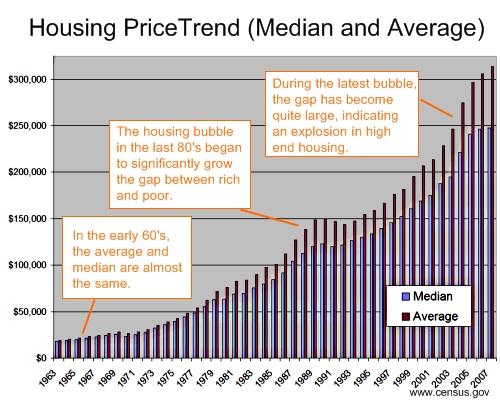
I decided to take a look at some of the facts to measure the bubble and finally set some expectations about the size of the bubble. First I looked at the average housing pricing for the last 45 years. I pulled all of the information from www.census.gov which is a terrific place to gather macro economic information.

Just quick look at the chart, and it is easy to see where the bubbles have occurred. There were indeed housing bubbles in 1969, 1980, and a slightly larger bubble in 1989. Once each bubble hit, the decline in housing prices never lasted more than one year. Until now.

It is clear from the data, that there was a tremendous spike in housing prices in 2005. Unbelievable as it might sound, housing prices jumped over 13% in one year! This was followed by a 9% jump in prices in 2006. Somebody was asleep at the wheel in the Federal Reserve. Warning bells were going off all around them, and they did nothing.

Perhaps the scariest part of the bubble is its sheer size. Not only are the spikes larger than any other historical precedent, the bubble has persisted longer than anything in the last 45 years.

The only good news on this chart is that median home prices appear to have peaked in 2007, and although the data is not yet in, it is a good bet that 2008 will be less than 2007. So it is clear that we are beginning the downswing, the only question is how long will it last. And how severe will it be?

Next let’s take a look at the same chart but including the average house price along side the median. There is some speculation that the root of the housing bubble is related to laws encouraging mortgages to minorities. This chart rebukes that theory.

There can only be one reason why the average is growing faster than the median. HIGH END HOUSING. Eyeballing the numbers, I would bet heavily that million dollar homes are driving the bubble, not $100K homes to minorities.

But wait, there is one more piece of bad news. The average house price was still growing rapidly in 2007. Note: that the median had hit a plateau. In fact, looking at previous bubbles, this is the first time that the average behaved differently than the median.

I worry about the underlying dynamics of our economy if the average is so much larger than the median. It suggest that the gap between rich and poor is growing. Living down here in Brazil, I believe that one of America’s strengths in the 60’s and 70’s was an extremely strong middle class.

But I don’t want to get off track. So the housing data looks bad. Of course, this was entirely preventable, but there is indeed some empirical evidence that this bubble could be equal to that of the Great Depresssion.

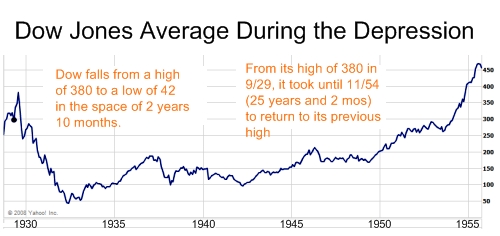
Lastly, let’s take a look at the Great Depression courtesy of Yahoo Finance. The Great Depression began in September 1929, when the Dow hit a peak of 380. The Dow did not hit bottom until close to three years later. Worse yet, it took over 25 years or a quarter of a century for the Dow to reach its pre-depression levels. Ouch! 25 years is a long time just to get back to break even on your stock portfolio.

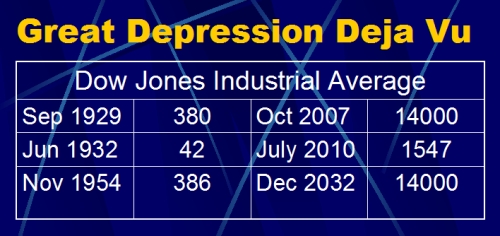
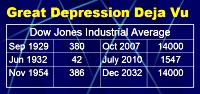
Although there are some indications that this financial crisis could equal the Great Depression. I personally believe that we can do much better. But for the pessimists in the group (and the media as well), here is a simple forecast using the Great Depression as a guide line. Once we see these numbers, it is easy to see why some people decided to keep their money in a mattress. Much safer.

One thought on “Measuring the Bubble (Depression Deja Vu)

Leave a Reply

Your email address will not be published. Required fields are marked *


Why the Bailout Will Fail

Yesterday, the House of Representatives approved the $700B bailout plan, and President Bush quickly signed it into law. Sigh! What I dislike most about this bill was that everyone including the President was acting in a panic. No one was calmly analyzing the underlying magnitude of the credit crisis, and the fundamentals that would drive our great country so close to the edge of a cliff. I’ll try to do that here.

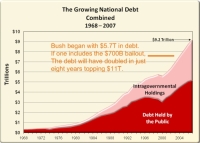
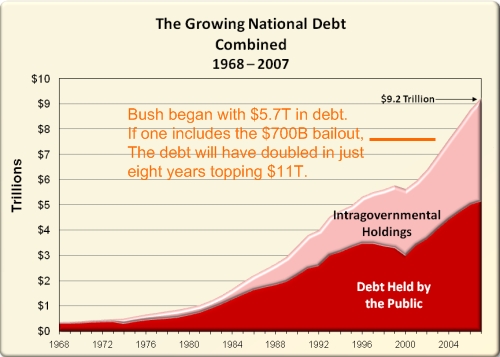
The first chart is a simple graph of the trend of our national debt. Bush inherited a $5.7T debt, and by the end of his presidency, it will most likely exceed $11T. In a short eight years, Bush and the Republicans have doubled the size of the deficit. Let’s put this another way. Bush created a deficit in eiqht years equal to all 42 presidents before him COMBINED. There are only two ways to create a disaster of this magnitude.

Create massive tax breaks. Not only must the tax breaks be massive, but they must provide little or no economic impact to the economy. This is no easy task, since normally tax breaks inherently give the economy a bump. Bush has proven with surgical accuracy that if you target the nation’s wealthiest citizens, as well as the wealthiest corporations such as Wall Street, oil companies, and pharmaceutical, it can be achieved. The key to Bush’s tax plans is to place as much money in as few hands as possible. Frankly, I would not have predicted it, but it appears to have worked like a charm.

Spend like there is no tomorrow. Once the Republicans took hold of both houses and the executive branch, it must have been like Dad giving the kids the keys to the summer home. LET’S PARTY! And party they did. There was no bill too expensive, and no earmark too small. Basically, there was no budget whatsoever. Of course, this bottomless-money-pit mentality also explains our stubbornness in exiting Iraq. In retrospect, it is amazing that the original budget for the war was $50B.

Look at the slope of the line during the last 7 years. We are in debt like we have never been in debt. America needs money and FAST!

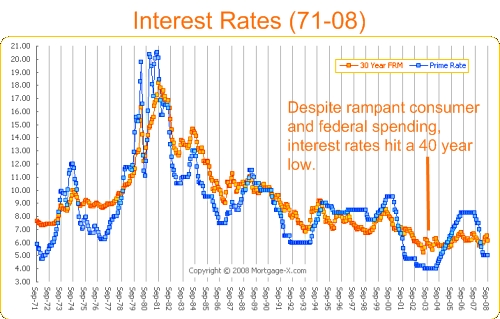
Which brings me to the next graph. If we are plowing through money, and we have made a conscious effort to reduce revenue (through tax decreases), one would think that America would have high interest rates in an effort to attract capital. This is where things start falling apart. The exact opposite is true. While our need for other people’s money was reaching addictive levels, our price for that money (interest rates), was abnormally low.

It makes no sense. Think of a guy with a serious gambling problem. Let’s call him Uncle Sam and he is on a bad run of luck. Sam normally gets his cash from Louie the Shark, but Louie is getting nervous because each time Sam needs more and more money. So this time, Louie says No to Sam. So Sam has no choice but to request a loan from Bobby Ballbreaker. Do you think that Bobby is going to give Sam a better deal than Louie? Of course not.

Then why are our interest rates so low? Today’s interest rates are lower than the Clinton era and the Reagan era. Who benefits? When interest rates are low, perhaps the first to profit is Wall Street. Low interest rates drives money into the stock market where people can get a higher return. This is a normal market dynamic unless the interest rates are artificially low.

I had a good friend remark close to two year ago. America is awash in cash trying to find a home. I have received hundreds of calls from companies trying to refinance my home. Note: I don’t have a mortgage on either of my residences. On top of this, during the Bush era, my mailbox was stuffed with preapproved credit cards. We should have seen it as a sign of things to come, but there was way too much money trying to find a home.

It is clear that this excess liquidity found its way into the mortgage market. With interest rates so low, any nut job could get a mortgage. Basically, if you have a pulse and a social security number, here’s a brand new home. Using the bubble mentality, it really doesn’t matter if the owner defaults if the value of the house is worth more. Of course, the wheels fall off the bus, when housing prices decline.

Please note: Unlike the presidential candidates, I do not believe this is a function of greed on Wall Street. It is a function of an interest rate that is lower than the underlying economics of the economy.

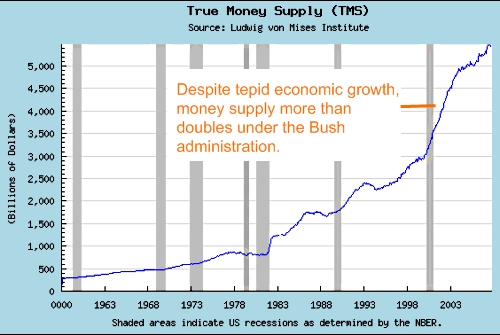
The last slide completes the picture. Who is the culprit? The Fed. There is only one way to pull off this economic illusion. As I discussed in Bubble Economics, the first thing is to greatly devalue the dollar. This ensures that America is an attractive place for foreign capital. Then the second piece is to expand the money supply to accommodate the influx of capital. Let’s make this clear. This was a conscious decision to expand the money supply to keep interest rates artificially low. As is painfully evident today, it created economic growth driven by the housing sector, but it was wholly unsustainable. There was only one outcome and it is the one that we are experiencing today.

Which brings us to the bailout. This bail out will fail for one reason alone. The US government is fighting the market. The underlying issue is that American interest rates are too damn LOW. The credit markets are frozen because they see an adjustment on the horizon. If we just let interest rates float as market dictates, credit would free up immediately, albeit at higher interest rates. This is the flaw. $700B can keep us at an artificially low interest rate for a period of time, but we cannot fight the market forever. Ultimately, interest rates must rise, and it will have a negative impact on the American economy, stock prices, and housing prices. $700B can delay the inevitable, but it cannot stop it from happening. For me, I would rather see it happen sooner rather than later so we can get on with our lives. Oh and we would also save $700B of taxpayer money. It is truly stunning that we think we can throw money at the problem, when the root issue is our free wheeling government.

One thought on “Why the Bailout Will Fail

  1. Two reasons the bailout will fail.

    1. The amount is to small and the allocation is corrupt.

    2. The CDS (Swaps) is est. to be 50 to 75 trillion depending on who you talk to and they don’t know for sure.

    No one knows how deep the cancer is not only in the U.S. but through out the world.

Leave a Reply

Your email address will not be published. Required fields are marked *


Bubble Economics – Don’t Panic

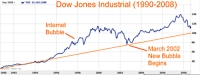
I am shocked at what is happening to our country right now. It is like an incredibly bad dream. I put together the following two charts (see below). The first chart is the history of the Dow Jones Industrial Average for the last 18 years. I drew a line (just a guess) of the normal sustainable rate of growth of the American economy. Independent on where you draw the line, it is easy to see 2 bubbles in the last 18 years. The first one is commonly referred to as the internet bubble or the dot com bust. And the second is the mess that we are experiencing. When looking at the magnitudes of the bubbles, they are similar in size. It is true that the DJ is not a surrogate for the market as a whole, but certainly if there is excess liquidity driving the mortgage market, then the DJ would at least have a residual bubble from the liquidity.
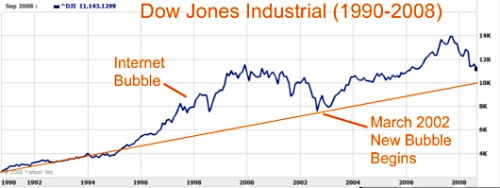
Which brings me to the second chart. If you look at the decline in the dollar, it almost exactly coincides in the rise in the Dow! I estimate the date of the bubble to be March 2002. First there is good news here. Bush says that the bubble began over 10 years ago. I don’t think so, and obviously the longer a bubble persists, the larger its magnitude.
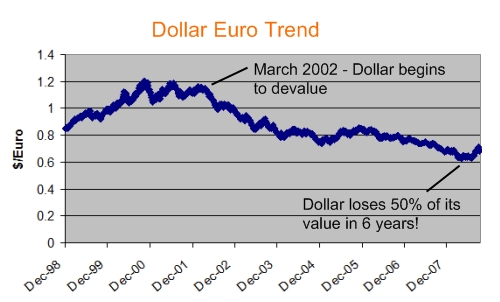
Now look at the dollar. It is clear that someone made a conscious decision to devalue the dollar. Now it makes sense to me! Here we have Republicans spending money like they won the lottery, and worse yet lowering taxes. But the kicker is that interest rates go DOWN! That makes no sense. Interest rates in Bush’s presidency are less than Clinton’s when we ran a surplus. How can that be? Something has to give, and it is the dollar.

Who would invest in the United States when interest rates are so low? No one. Of course, as the dollar weakens, investing in the US becomes more attractive so money flows into the economy. But this is all so upside down! People are investing in our country because we have a weak currency, not because we have a strong economy! Through out all of my life no matter what president, the dollar has always been strong. Until now. And not only has it fallen, it has fallen off a cliff. Why? It seems like there can only be one reason, to attract foreign capital. It is evident to anyone that this strategy is unsustainable and ultimately the bubble must burst.

There is one conclusion that I can make. This is not something that happened to us. This is something that someone consciously did. The root of this problem is our money supply. Someone has been increasing the money supply at a much faster rate than our underlying economy can support. This is very very dangerous and I don’t believe it has happened in my life time until now. I do not know why someone would do something so hazardous with our economy, but I can speculate.

When the money supply increases, credit loosens automatically, the economy gets a bump. It is an artificial unsustainable bump, but nevertheless a bump. It is good politics to show economic growth, and so the Bush administration continued to force the dollar lower to show artificial economic growth. During the internet boom, although there was a bubble, there was at the core true economic growth. American companies such as eBay, Google, Yahoo became worldwide leaders of the internet. Furthermore the global demand for the internet, further entrenched American companies such as Intel, Microsoft, and Dell into the global economy. The bubble popped but underneath the economy was strong. Plus our goal was not to create a bubble. The reality is that the Bush administration was using the bubble as a proxy for economic growth. So once the bubble pops, what do we got underneath? NADA.

So who is responsible? Who would increase the money supply? There is only one person that has this responsibility. Federal Chairman, Alan Greenspan. Dude, what were you thinking? This is more than bad judgment, and I really can’t believe that greed would be a factor. What were you thinking? I do find it strange that as the entire country is running around like chickens without heads, that you remain silent.

I am not an economist. I am just a really concerned citizen, that wants to inject some analysis and thought into a dialog that appears to be lacking of both. Here are some conclusions. Take them for what they are worth.

Numbers. Economics are all about numbers. Economists are hard core mathematicians. But whenever we discuss this problem or the bailout, no one is quantifying anything. When did this problem begin? How large was the bubble? This is why I did my little quickie analysis, because it is a huge hole in our plan. The answer to this problem is in the numbers and no one is looking at the numbers. The only number we get to know is $700B. This is beyond pathetic. It is reckless and irresponsible.

Bubble size. Just based on my numbers, it seems that the relative size of the two bubbles are comparable. I agree that the Dow Jones is not a surrogate for the economy as a whole, but the last bubble burst without a bailout and we ended up OK. What is driving the panic? What makes us think that this is the worst since the Great Depression? Again, where are the numbers? We had a saying at Gateway, “In God We Trust, all others bring data.” Give us data that backs up the panic.

Responsibility. Let me make a key point. This should never happen. Never, never, never. It is someone’s job to watch critical indicators (also called fundamentals) such as the price of the dollar, unemployment, in flows of capital, and so on. The warning bells have been going off for years and no one has done anything to fix it. Worse yet, it is clear that the bad acts just continued unabated. Not only was this 100% preventable, it was easily preventable. We need to know who and why before we can trust again. This guy Paulson wants $700B of our money. Before this all happened, I had know idea who he was. Was he part of the problem? Or maybe he is incompetent? These questions must be asked, and no one Republican nor Democrat should be offended when they get asked.

Spending. What is the root of the problem? The Republicans from 2000-2006 have spent like no other Congress in the history of the nation. We have the biggest, humongous, behemoth government in the history of the WORLD. The waste turns my stomach, plus it is 100% contrary to the vision of the great Ronald Reagan. The smaller the government, the lower our taxes, and the less intrusion in our lives. The people in power are NOT Republicans nor are they Democrats, they are the worst of everything, and in my view, THEY ALL SHOULD LOSE THEIR JOBS. I am appalled by the spending in Washington as if God wrote a blank check, and said “Go have fun kids.” Geez.

Taxes. Then on top of that, they lower taxes. This is an abomination. Furthermore, anyone that opposes tax decreases, is labeled as UnAmerican or Liberal. These guys are so clueless. Every American has to balance a checkbook, and spend within their means. Is it so much to ask our government to do the same thing?

Balanced Budget. We have to demand that our officials live within their means. Increased spending should NEVER be coupled with lower taxes. It does not work that way in the real world. Does it bother anyone that the war was supposed to cost $50B and now we are going on $1000B? We need to instill a discipline in Washington that somehow has been thrown out the window in the last 8 years. This is the most important thing we can do.

I am going to say it out loud. People. America is BROKE. We are not the richest country in the world. Not even close. Why is our currency falling off a cliff? Because we do not have the money to peg our currency. All of our wealth has been squandered away. It is all gone. The only hope is that we start living within our means.

Panic. Stop the panic. Stop the panic. I do not want the people responsible for our economy in a panic. I want them thinking clear and looking at lots and lots of numbers. We need clear thinking and unemotional leaders looking for solutions. Not just quick fixes but real solutions. The Dow fell 700 points in a day. Big deal. We are dealing issues with much larger than that. I as a citizen want to know the root cause. I want assurances that we will never get in this situation again.

Let me say it again. I hate the panic. The chances we find an intelligent solution diminish greatly the more our leaders panic.

Conclusion In conclusion, I am not seeing evidence for the panic we are seeing from our leaders right now. Yes, we have a problem, and yes it will be painful. But we should not panic. If we made it through the internet bubble, can you not survive this bubble as well?

I have not yet heard anything from our leaders that indicates that anyone understands the true underlying problem, and I feel like they are just shooting in the dark. Lastly, I do not trust this man Paulsen with $700B of our money when he is the prototype Wall Street insider. Kudos to the Republicans for killing the $700B Panic Bailout Plan. There is a better solution out there if we only take the time to find it.

Why did I write this? Because I am disgusted to see how the President and Congress are behaving. It’s like watching Romper Room. We deserve better and we should demand it. If you agree, please pass this post on to as many people as possible. Thanks for reading.

Rob
One thought on “Bubble Economics – Don’t Panic

  1. Yes, as Mike pointed out, Reagan may have had a vision of small government, but it was as small government for ordinary people. Reagan believed in and implemented a very big government for concentrated power. There was nothing really “great” about Reagan, it is all mythology. Look at his record. He had the largest budget deficits in history until Bush 2 took office. He helped set in motion the deregulation that has reduced standards and lead to this financial bust. Furthermore, this deregulation has effected quality in everything from the FDA to trucking safety as well. One cannot on one hand praise Reagan, while denigrating Bush, as they are too similar to notice any significant contrast.

    Even speaking about a vision of Reagan is not logical. Reagan was an ex-actor who climbed to power by doing what he was told. He was elected to the screen actor’s guild because he did what Lew Wasserman told him he received a steady stream of movie roles through Wasserman’s MCA. He wore a fake cowboy hat and was photographed walking around his “ranch” with a chainsaw doing yard work. He and was a media construction. He could not read complicated material, quoted the Reader’s Digest as CIA material, had a child’s understanding of the economy and of science (recall the Star Wars Program?), and had his “mommie” schedule meetings based upon astrological timing. I say lets get real about who Reagan was and what he did and not rely upon mythology created by PR firms or an uncritical media.

  2. To be fair, Reagan spent money like crazy and cut taxes, too, and it was a problem (recession in the late 80s, early 90s). Dems are going to win and win big. Things should improve in the short term, although control of the white house and congress both may let the Dems spend unfettered, too.

    I’m not watching my portfolio — I’m young and want to be in for the big up days. I am enjoying the effect on the exchange rate recently as the money moves from stocks to cash.

  3. I liked the two charts, and looks like an interested potential correlation, but the article is not deep, and does not reflect any real analysis of the situation. In particular, the basis measures of money supply show that it has not been growing faster than the economy. And the biggest contributor to this mess is likely Clinton and the democratic congres, who, through the Community Reinvestment Act (“CRA”), pushed banks to grant mortgages to borrowers who could not afford them for the sake of increasing home ownership, combined with senators like Dodd and Obama who were receiving substantial contributions from Freddie and Fanny, while the latte were permitted to become overleveraged. Reforms, including those requested by McCain, were blocked by the Democratic Congress, along with some complicit Republicans, who “were on Freddie and Fannies payroll.” Big, irresponsible government that cannot see past the next vote, or to recognize the unintended consequences of their “well meaning” policies, is the cause and the problem.

  4. Rob,
    Great article and I definitely feel your pain and frustration. You have to realize that we are being governed by a higher order called the Bilderberg Group (must read book called the “The Bilderberg Group” by Daniel Estulin). This is a group of the elite such as the Rothchilds, Rockerfellers, and many government officials like the Clintons, Bush’s, Kennedy’s, Kissinger, JP Morgan, Warren Buffett, Kings, Queens, Prince Charles, Albright, Feldstein, Bernanke, Greenspan, Paulson, Condi Rice and so on… They control or are involved in all Central Banks including the US Fed Reserve. The CFR, Trilateral Commission, and the Club of Rome are the wealth behind the United Nations. The United Nations ultimate goal is to create a global society which consists of 1 World Government, 1 World Currency, 1 World Religion and take control of all natural resources and a universal education system. The way the U.N. accomplishes this feat is to devalue all currencies so that we have no choice but to create a world currency (Great article from today: http://www.washtimes.com/news/2008/oct/01/foreign-economists-prod-us-on-global-plan/ ). Read Obama’s “Global Poverty Act S-Bill 2433” that was just passed this July and the U.N. Millennium Plan (If you think you are scared now wait until you read these bills). You could also google John McCain’s “League of Democracies”. Please don’t think this is conspiracy theory until you read at least the U.N. Millennium Plan. You will begin to see that everything that has happened over the last 100 years is by no ACCIDENT or incompetent leaders. Another great read is “The Creature from Jekyll Island” which explains the creation of the Federal Reserve where this really all began. It all has been done for a specific purpose!!! Socialism will PREVAIL. We are SCREWED!!!

  5. take a look a this guys web site http://www.chrismartenson.com the crash course…..

    Ready to learn everything you need to know about the economy in less than two hours?

    The Crash Course is a condensed online version of Chris Martenson’s “End of Money” seminar. The first chapters of the Crash Course are already available; additional chapters will be added as quickly as time allows. Watch the Breaking News page to find out when new chapters are posted.

  6. I agree completely. It’s absolutely astonishing that no one representing us, or our country, has even the slightest understanding of what’s taken place. Infact the more I see the more I think they are not even capable of understanding the questions much less the answers. Many of todays online service people can read script with more conviction than what I’m seeing from our representatives.

    To say that I am in fear of the future is an understatement.

Leave a Reply

Your email address will not be published. Required fields are marked *


Cooking with Bok Choy

One of my favorite Chinese vegetables in Bok Choy. I like to put it in soups, and many Chinese recipes. Unlike many other vegetables, both the leaves and the stems are tasty in their own unique way. Perhaps, one of the best Bok Choy dishes is beef/chicken with oyster sauce. I was having a problem that each time I cooked this dish, the dish would turn out very runny, and the delicious oyster sauce was diluted. After many starts and stops, I finally figured out some of the intricacies of cooking with Bok Choy.
I’ll use Beef Bok Choy with Oyster Sauce as an example.

Cut the bok choy and separate the leaves and the stems into two piles. Cut the beef into small round pieces. Beat each piece of beef individually with a meat tenderizer. This is a key step to make the beef extra tender and more flavorful. Create the marinade for the beef. I use one tablespoon cooking sherry, 1 tablespoon soy sauce, 2 tablespoon cornstarch, 1 tablespoon sugar, and a dash of Accent. Note: This recipe, I have doubled the amount of cornstarch to compensate for the runoff of the bok choy.

Once the oil in the wok is very hot, throw the bok choy stem pieces in the wok, and also 2-3 cloves of mashed garlic. Stir vigorously for one minute. Then add the bok choy leaves to the mixture. Stir until the leaves have been cooked. Remove and place the bok choy stems and leaves in a strainer. This is a key step. The key point is to strain off as much liquid as possible.

Next, heat some more oil, and quick fry the beef in the wok. Once the beef is quick, throw the bok choy and 1-2 tablespoons oyster sauce, and mix quickly. Don’t spend too much time mixing because you don’t want to overcook the beef and the bok choy.

In summary the two key differences in cooking with Bok Choy and other Chinese vegetables:

1. Strain in a strainer
2. Add a second TBSP of corn starch into the meat marinade.

Good Luck.

Next, you need to add the marinade for your beef or chicken. Add one more teaspoon of corn starch to the marinade than normal. The reason is that the extra corn starch is required for the run off of the water from the bok choy.

Now cook the bok choy in the wok. Watch carefully the bok choy, and do not over cook the bok choy because the more it is cooked the more run off. Once the bok choy

Leave a Reply

Your email address will not be published. Required fields are marked *


Lessons From Iraq

I just finished watching the first presidential debate, and one of the first questions was what are some of the lessons that can be learned from the war in Iraq. This should have been a softball question for Obama because in order to learn we have to admit our mistakes. McCain response was clear that he was not going to admit any mistakes. In fact, he just reveled in the wisdom of the surge. Worse yet, Obama did not seize the opportunity, basically said we should leave Iraq and shift to Afghanistan.

DAMNIT! Neither candidate can learn from the war in Iraq? That’s a scary thought. The reality is that there are numerous lessons to be learned, and it pains me to think of the state of our country that I, a humble citizen, needs to write these lessons for posterity.

Unilateral. Bush likes to refer to the Iraqi War as the Global War on Terror. Nothing could be further from the truth. We have no allies in the war of Iraq. The Coalition of the Willing was fragile at best, and whatever allies we had quickly bailed once they realized what a mess we had entered. Worse yet, in Afghanistan we had the world united to fight Osama Bin Laden. If we could have framed the war as the World against Osama Bin Laden, it would have ended a long time ago. Unilateral is also horrible from a cost standpoint. Now that we are going through a financial crisis unequaled since the Great Depression, wouldn’t it have been nice if we had had other nations to share the costs?

So the lesson to be learned is that we need allies, and part of having allies is listening to them.

Unprovoked. Not only did we enter this war alone, it was unprovoked. A truly lethal combination. There are two large negative aspects. Our national standing suffers since both our allies and our enemies find it hard to deal with a country that behaves unilaterally without provocation. More importantly, it shows off an ugly side of America, arrogance. It is clear through the partisan battles about this war, that many Americans believe that we are the world’s police cop, and hence unprovoked unilateral actions are our God given right.

The lesson here is clear. Quick and swift unilateral action should be in retaliation to a provocation.

Intelligence. George Tenet said finding WMD in Iraq was a Slam Dunk. Can you imagine where we would be if Tenet had said instead, “President Bush, there is a decent chance that are no WMD in Iraq and Saddam is bluffing.” We can’t go back in time, but I can postulate forcefully that we would have never entered the war in Iraq. Of course, the intelligence failures did not end with WMD. We believed that we would be greeted as liberators rather than invaders, and the list goes on. Then Bush gives the guy a medal! This is the guy that oversaw perhaps the largest intelligence failure in the history of the country.

When you are handing out medals, you are not learning from your mistakes. You are reveling in them. The lesson here is that our intelligence sucks and we should take our intelligence with a grain of salt until significant improvements and changes are made.

Changing the Mission. First, we say we are protecting ourselves from WMD. We capture the country and scour for the elusive bombs. Sure, we look like boobs, but the mission is accomplished, there is no threat of WMD. Not even close. What do we do? We change the mission. Now we are out to topple a brutal dictator. I am proud to say that our military nailed it. The guy was hiding in a hole for God’s sake, and we found him. Boo ya! Let’s get out here, and great job.

Ummmm. No. There’s another mission. What? Yes, we now want Iraq to become a beacon for democracy. Say what? Yes, a shining beacon of democracy with whipped cream on top. This is absurdity at its worse, and there is a huge lesson here. Congress did not authorize the toppling of Saddam, nor did they authorize the beacon of democracy. Once we realized there were no WMD, the president should be required to return to Congress for further authorization. Maybe Congress would have been bitten on toppling Saddam, but the beacon thing would never have passed muster. Another valuable lesson is that our military is excellent at achieving certain tasks. We secured a hostile nation and we found and killed their dictator. However, there are limits to what can be achieved militarily and creating democratic beacons is not one of them.

Know Your Enemy. Osama Bin Laden has already stated that he views his jihad against the United States as a financial war. Why is no one paying to this attention to this? Do we not care? This is not about suicide bombers and road side explosive devices, this is about money. Recent estimates put Bin Laden’s worth at $300M, which is a paltry sum compared to the mighty United States. Think about it. Let’s say that Bin Laden has spent about $100M in the war in Iraq, and we have gone through $500B. That means for every one dollar that Bin Laden spends in Iraq, we plow through $5000. That’s a pretty good return on investment for Bin Laden.

What about the surge? Does Obama want us to blow more or less money in Iraq? Bin Laden wants this war to drag on as long as possible because for every dollar he spends, we spend $5000. I believe that the last thing Bin Laden wants is for America to leave Iraq. If we do, it is because we can no longer afford it, and he will declare victory.

But wait, aren’t we going through an economic crisis? Maybe, just maybe there is a lesson to be learned? Many can argue that the Cold War was won because the US military build up pushed Russia into an intolerable economic situation. The lesson learned is obvious. War’s cost money and no one, including the United States, has an infinite supply.

Admitting Mistakes. I believe very firmly that admitting your mistakes quickly is the secret to success. Learn from them, and create a new plan. No one is always right. To be consistently right is a matter of admitting and eliminating mistakes not avoiding admitting them. Unfortunately, the Bush administration and apparently John McCain, believe that mistakes are NEVER to be admitted. First, they believe that admitting mistakes emboldens the enemy. Of course, that is horse radish. Having no allies emboldens the enemy. Changing course quickly and aptly would do the opposite.

Additionally, the admission of mistakes emboldens the other party. This is true, but the solution is not to avoid admitting mistakes. Jim Lehrer’s question was so great because one of the cornerstone’s Bush’s administration is never to admit your mistakes and hence never learn from them. So the last and final lesson is that we as a nation must learn from our mistakes and the first step is admitting them.

One thought on “Lessons From Iraq

  1. Rob, if you aren’t aware of this book– Griftopia by author, Matt Taibbi– is an unabashed double barreled BLAST in the face of U.S. political hypocrisy, I think you will truly enjoy reading Matt Taibbi.

Leave a Reply

Your email address will not be published. Required fields are marked *